
Class 7 Worksheet on Active and Passive Voice

Class 7 Worksheet on Active and Passive Voice
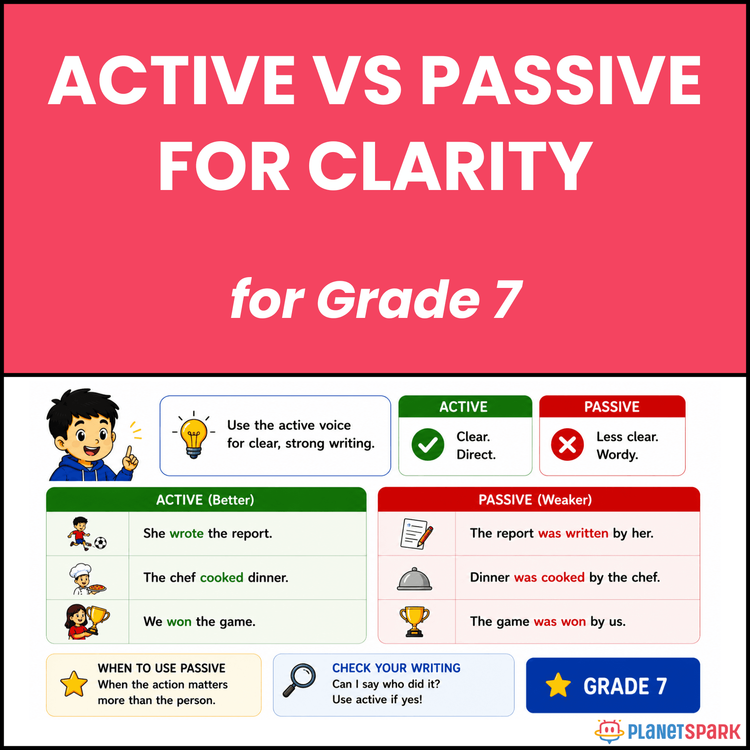
Speak Clearly: Active vs Passive Voice for Clarity for Class 7
This Grade 7 worksheet on Active vs Passive Voice for Clarity helps students understand how sentence structure changes meaning, focus, and readability in writing. Through identifying voice patterns, sentence transformation, rewriting exercises, and grammar practice, learners improve sentence clarity, grammar accuracy, and effective communication skills.
Why Active and Passive Voice Matter in Grammar?
Understanding active and passive voice helps students write clearer and more purposeful sentences. For Grade 7 learners, this topic is important because:
1. It improves sentence clarity and readability.
2. It helps students identify the subject performing the action.
3. It strengthens grammar accuracy and sentence structure skills.
4. It develops stronger academic, descriptive, and formal writing abilities.
What’s Inside This Worksheet?
Students move from identifying active and passive structures to rewriting and constructing clear sentences through guided grammar practice.
🧠 Exercise 1 – Identify Active and Passive Voice
Students underline active verbs and circle passive verb phrases to recognize differences in sentence structure and focus.
✏️ Exercise 2 – Multiple Choice Questions
Students choose the clearest sentence by identifying correct active or passive voice usage based on meaning and clarity.
📋 Exercise 3 – Sentence Rewriting
Students rewrite sentences by changing voice, adding helping verbs, fixing passive structures, and correcting incomplete sentence patterns.
📝 Exercise 4 – Fill in the Blanks
Students complete a passage using suitable active and passive verb forms to strengthen understanding of sentence voice and grammar accuracy.
✍️ Exercise 5 – Paragraph Writing
Students write a short paragraph on “My Favorite School Activity” using mostly active voice sentences to improve sentence clarity and engagement.
A strong response will include sentences such as “Ravi read the notice aloud.” instead of “The notice was read aloud.” and “The cake was baked by Riya.” → “Riya baked the cake.”
✅ Answer Key (For Parents & Educators)
Exercise 1 – Active and Passive Voice
1. Active – wrote
2. Active – completed
3. Passive – was delayed
4. Passive – were distributed
5. Passive – was closed
6. Passive – was checked
7. Passive – were displayed
8. Active – arranged
9. Active – delivered
10. Active – announced
Exercise 2 – Multiple Choice Questions
1. c) Ravi read the notice aloud.
2. c) Neha delivered the charts.
3. a) Students cleaned the room early.
4. a) Rain delayed the match.
5. b) Sir checked the homework.
6. c) The cooks packed lunches.
7. a) Asha won the prize.
8. b) The guard closed the gate.
9. b) The peon switched off lights.
10. b) Meera wrote the essay.
Exercise 3 – Sentence Rewriting (Sample Answers)
1. Riya baked the cake.
2. The ball was kicked by Ravi yesterday.
3. The room was cleaned by students.
4. The letter was posted by Neha.
5. Cricket was played by the boys.
6. The principal was praised by the class.
7. The plants were watered every day.
8. The homework was checked by the teacher.
9. The poem was recited by Asha.
10. The chairs were arranged by the monitor.
Exercise 4 – Fill in the Blanks
1. arranged
2. was delivered
3. observed
4. were clicked
5. were selected
6. were distributed
7. thanked
8. cleaned
9. was written
10. improves
Exercise 5 – Paragraph Writing (Sample Answer)
My Favorite School Activity
My favorite school activity is participating in science exhibitions. I enjoy creating working models and explaining them to visitors. My friends and I prepare charts, arrange the display table, and practice our presentation together. During the exhibition, teachers ask interesting questions, and we answer them confidently. I also enjoy learning about projects made by other students. These activities improve my teamwork and communication skills. Science exhibitions always make learning exciting and enjoyable.
Help your child strengthen grammar and communication skills through structured practice that improves sentence clarity, voice recognition, and effective writing.
🔖Book a free trial!
Frequently Asked Questions
Active voice focuses on the subject performing the action, while passive voice focuses on the action or receiver.
It helps them vary sentence style and understand different ways of presenting information.
It is useful when the action is more important than the doer or when the doer is unknown.